
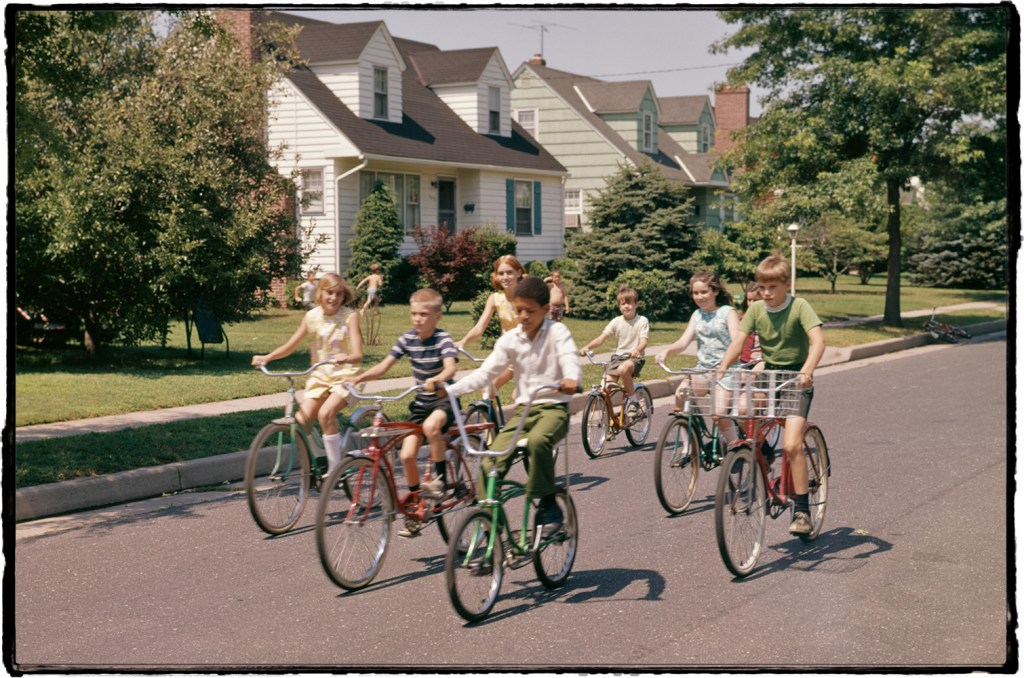
Neighborhood children riding bikes down a suburban street in the 1960s pre-helmet era.
Some of you may remember Mister Rogers’ Neighborhood, a very popular children’s television program that ran from 1968 to 2001 on PBS.
I used to watch it with our sons. Sesame Street’s fast pace was fun and educational, but there was something very calming about Mr. Rogers. He spoke softly and gently. He had a neighborhood of friends; puppets and real people. I mostly remember the puppets.
Some of the puppets from Mister Rogers’ Neighborhood were:
- Daniel Striped Tiger: a shy, gentle tiger who is both timid and brave
- King Friday XIII: the ruler of the Neighborhood of Make-Believe
- Lady Elaine Fairchilde: a mischievous, troublemaker; brave, sassy, and always ready to speak up
- X the Owl: a fun-loving, easy-going, relaxed owl who loves to learn
- Prince Tuesday: son of King Friday and Queen Sara
A live character I remember is Mr. McFeely, the mail man. Each character was designed to reflect a different characteristic or personality trait, reminding us that we may be different but each of us is important.
A recent article in The Atlantic magazine, “The Anti-Social Century” by Derek Thompson,1 indicates that the neighborhood experience many of us grew up with is disappearing. The upgrades of total-house air conditioning which seals us in snugly, attached garages, and most especially the option for living our lives on the “net” has moved us to a neighborhood of one.
Thompson begins the article by reminding us that the first half of the 20th Century was extraordinarily social. From 1900-1960, church membership surged, as did labor union participation. Marriage rates skyrocketed post World War II and along with that came the baby boom. As the WWII vets grabbed GI housing loans, suburbia was born. And along with suburbia came the automobile in much larger numbers. No longer waiting at the corner for the bus and chatting with your fellow commuters, you drove alone. You didn’t need to meet your buddies at the corner tavern or the ladies at their coffee klatch. Everyone had television. So, with our own house, our own car, our own television, and our own phone line (for those of you who remember party lines) we were all set in our own private worlds.
Robert Putnam, in his book, Bowling Alone2, states it more succinctly. Putnam addresses the shift he observes in U.S. moral values in the 1970s, towards an “unbridled individualism” which he attributes to the rapid role of the automobile and the television set. That was before the wide spread of the Internet. We’re no longer bowling, period. We’re watching it on ESPN or some Internet server.
In The Atlantic article, “The Anti-Social Century,” Thompson writes of being “Phonebound” and while he acknowledges the convenience of sending texts and videos as a form of communication, it does not replace live, face-to-face communication. According to Thompson’s research, the typical person is awake for 900 minutes a day. American kids and teenagers on average spend 270 minutes on weekdays and 380 minutes on weekends gazing at a screen, which is 30% of their waking life. Since the 1990s and into the 2000s, time spent with other teens has dropped by nearly 50%.
What Thompson reminds us – and we know this – is that the best kind of play is outdoors with other kids, where the kids can work out the nitty gritty of the play details; who’s batting first, whose turn it is to turn the jump rope, does it count if you step on a line playing hopscotch, you’re out if you cheat… all the things we grew up with.
We thought we were just having fun. We were, but we were also developing necessary social skills which aided us in our adult years, such as accepting differences, resolving conflicts, learning what we were good at – what the other kids were good at, a sense of belonging, team spirit…
Thompson cites another study by sociologist Patrick Sharkey.3 Sharkey’s research led him to the term, “Homebound.” I think most of us can relate to Sharkey’s observations. Post-pandemic, Sharkey found that Americans are more likely to take meetings from home, shop from home, be entertained at home, eat at home, and worship at home. Sound familiar?
An added component to the above Homebound is that today, the typical American home has become bigger, more comfortable, and more entertaining; think the explosion of multiple TV stations, film networks, video games, etc. The list goes on. So, less motivation to step away from the TV screen or the Internet screen and leave home for a get-together with friends, a walk in the park, a social event at your place of worship or in your neighborhood.
Thompson shares research from Marc J. Dunkelman4, who suggests we look at a triad “structure” (my word) to observe the impact of technological advances in the context of relationships. The “inner ring” of the triad is the opportunities that today’s technology allows for family and close friends to stay connected. Facetime, Zoom, and texting allow us to stay closely connected to family and friends near and far. I know I am not the only one who receives daily photos of our two-year-old grandson, which we enjoy.
Tech advances also allow us to connect with the “outer ring,” what Dunkelman terms “the village,” where we connect with those with whom we share interests; sports, church groups, book clubs, etc. My spouse and our oldest son share a keen interest in the St. Louis University Billiken Basketball team. I know when the phone rings about 30 minutes post-game, when his Dad is back home, it is Francis calling to discuss the game. So “inner ring” and “outer ring” – all good.
But Dunkelman’s research maintains that the “middle ring” is problematic. While there are advantages to being Homebound and Phonebound, the downside is that it is making society “weaker, meaner, and more delusional.” What we lose in the “middle ring” is that sense of “neededness” which is different than “being needy.” Social scientist Richard V. Reeves5 describes “neededness” as the reality that we are essential to one another; children need parents, co-workers need their team members, neighborhoods need each other to maintain our neighborhoods and keep an eye out for each other. We need friends to hang out with. We need to be all in this together. Remember Barbra Streisand singing, “People who need people are the luckiest people in the world”6? Being needed gives us meaning and a sense of purpose; a sense of belonging.
I know I tossed a lot out to you this month, but it is freeing to be able to articulate what we know is, in fact, happening; to give it a name.
Let me close by noting that if there is one season that brings Hope it is the season of spring; tulips are blooming, redbuds are waving, the lilac bush is fragrant, birds are mating, and lawn mowers are purring. Step out of your Homebound-Phonebound world and enjoy the gift of nature. And remember to wave to your neighbor!
Bridget
References:
1. Derek Thompson, “The Anti-Social Century.” (The Atlantic, January 8, 2025).
2. Robert Putnam, Bowling Alone. (Simon & Schuster, 2000).
3. Patrick Sharkey, “Homebound: The Long-Term Rise in Time Spent at Home Among U.S. Adults,” 2024. (Sociologist, Princeton University).
4. Marc J. Dunkelman, The Vanishing Neighbor: The Transformation of American Community. (Fellow, Watson Institute for International and Public Affairs at Brown University).
5. Richard V. Reeves. (Social Scientist, Senior Fellow at the Brookings Institution and President of the American Institute for Boys and Men, Washington, D.C.).
6. “People” from the Broadway musical, Funny Girl. (Composed by Jule Styne, lyrics by Bob Merrill, 1964).

 The Annunciation Blog
Bridget,
Your blog info is very interesting. I really enjoyed reading how cleverly your writing is. I appreciate the reference resources too.
Thank you for sharing. May the Easter season continue to bring your life enjoyment and bless you in pleasant surprised ways.
Mary Lou
LikeLike